
Monsoon-Season Plumbing: Protect Your Home Before the Storms
By late afternoon the sky to the east turns a bruised green-grey, the wind comes up, and dust moves across the road in sheets. Then the smell arrives — rain on dry dirt and creosote after months of heat — and ten minutes later water is running across patios and driveways into places it has not reached all year.
For most of the year a desert home asks almost nothing of its drainage. Monsoon season changes that in an afternoon. A little preparation, done before mid-June, is what keeps a storm from finding the weak spot.
Why monsoon season catches desert homes off guard
The desert spends ten months teaching a homeowner to think about heat and dryness. Then, from roughly mid-June into September, it does the opposite — and the problem is rarely the total amount of rain. It is the speed.
Hard, sun-baked ground does not absorb a sudden downpour; the water sheets straight across the surface instead, and a great deal of it arrives at once. Dust and gravel that sat still for months all start moving together. A patio drain that looked perfectly fine in May simply cannot keep up in July. The first real storm of the season is usually the most revealing one, because water takes the lowest path available to it — whether or not that path was ever meant to carry water. The National Weather Service issues watches and warnings through the season; the plumbing side of being ready is making sure the water has somewhere to go. That is why this is preparation you do before the storms, not during them.
Where the water goes — outdoor drains and your foundation
A West Valley patio or side yard quietly collects debris all year: dust, gravel, dead leaves, palm litter, the bit of rock that irrigation washes into a corner. Through the dry months none of it matters. Then the monsoon hits, and the yard drains, area drains, and patio scuppers are suddenly asked to move a large volume of water immediately.
If they are even partly blocked, the water backs up fast — and instead of flowing away it begins to pool against exterior walls, sliding-door tracks, the garage slab. Most West Valley homes in Sun City Grand, Verrado, PebbleCreek, and the surrounding communities sit on a concrete slab, and water standing against the edge of a slab is exactly what you do not want. The sign is not always dramatic flooding; often it is subtler — a mud line along a wall, concrete that stays damp long after the storm, a drain that bubbles and empties slowly.
Grading — the slope of the soil itself — matters too, though that is landscape work rather than plumbing. The drain pipes are the plumbing side, and keeping them clear is the part worth handling before the season starts: a blocked area drain is far easier to deal with in dry weather than in a July downpour. If an outdoor drain is sluggish or clogging repeatedly, our drain cleaning service covers the kind of blockages we see around West Valley homes.
Storms and your sewer line
A heavy storm tests more than the yard. When stormwater overwhelms the drainage around a property and the ground saturates, the pressure changes underground can bring out weak points in a sewer line that stayed quiet all through the dry season.
The early signs are small: a toilet that bubbles during a storm, a shower drain that gurgles, water draining slower than usual, a faint sewer smell that shows up briefly after heavy rain. Older sewer lines — in parts of Avondale, Sun City, and other long-established West Valley neighborhoods — tend to be the most vulnerable, especially where tree roots have worked into the joints or decades of soil movement have shifted a pipe. Saturated ground can then wash dirt into a cracked line and turn a slow problem into a real backup.
It is worth knowing where your main sewer cleanout is — the capped pipe rising from the ground outside the house — before a storm, not during one. If a backup happens, that is the access point used to relieve and clear the line. If a home already has occasional slow drains or backups, monsoon season tends to make them worse; our sewer line page covers diagnosing and clearing the main line.
After the storm — humidity, grit, and hidden trouble
When the storm passes, the conditions it leaves behind are their own issue.
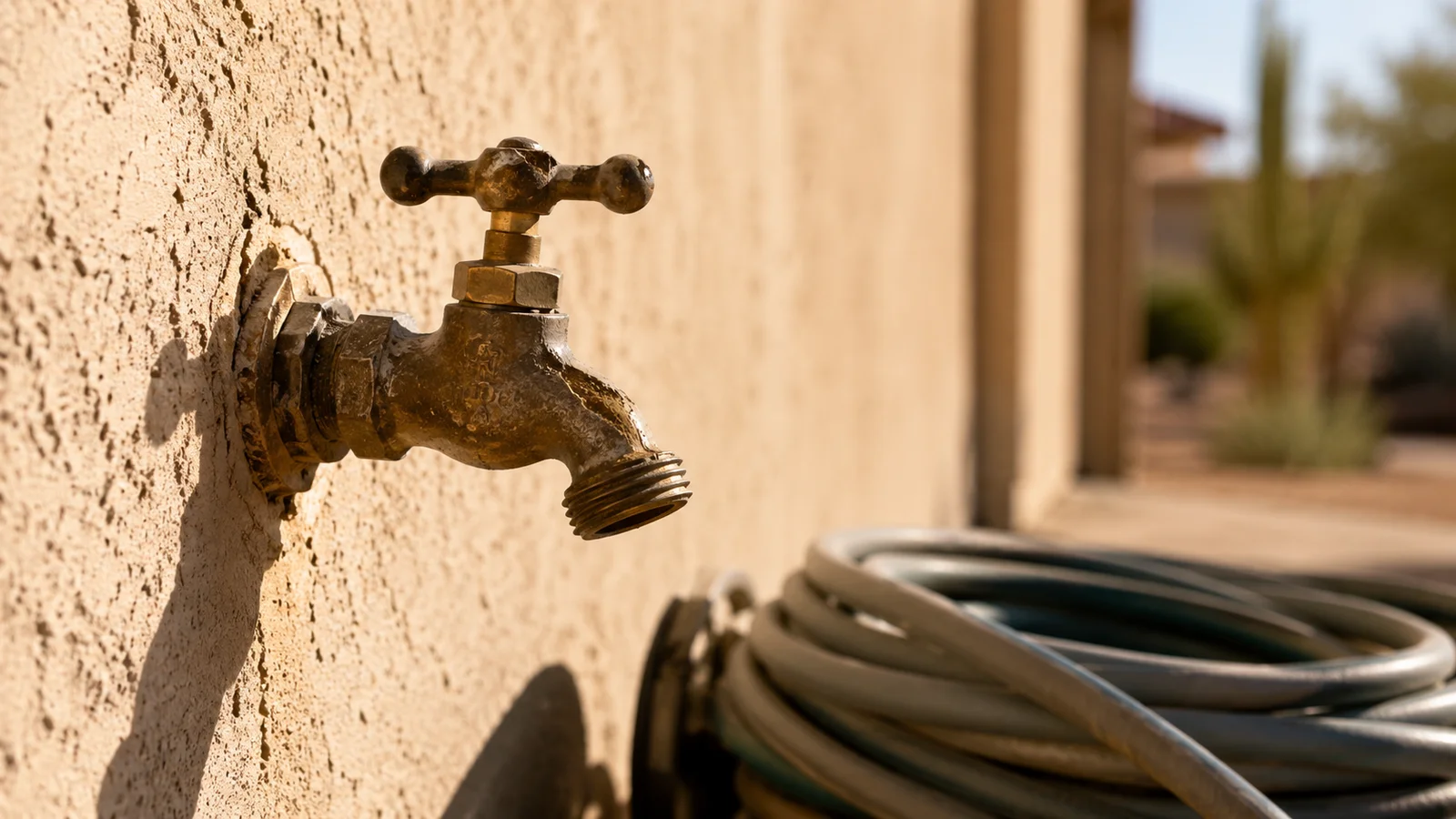
Monsoon brings a humidity spike, and humidity slows evaporation. A slow drip under a guest bath sink or at the water-heater pan that went unnoticed all spring — because the dry air kept drying it out — now stays wet, and a cabinet that stays wet is all mildew needs. It is a good hour to spend after the first big storm: open the cabinets under sinks, look at the water heater and its drain pan, check the back corners. Our guide to detecting a hidden water leak covers what to look for. The fine grit a dust storm drives into everything can also work into the moving parts of outdoor hose bibs, leaving them stiff or weeping — worth a check while you are walking the property.
Your pre-monsoon checklist
A little done in dry weather saves a lot during a storm. Before the middle of June, walk the patio, pool deck, and courtyard and clear every surface drain — pull the grit and leaves off the grates and run a hose through to confirm each one flows. Find your main sewer cleanout and make sure it is not buried under landscape rock or a shrub, so it can be reached quickly if it is ever needed. Check the outdoor hose bibs for drips and make sure they close fully without binding. Look at the water heater's drain pan and confirm it is dry and its line is clear.
Then, when the first storm actually arrives, watch. Stand at a window and see where the water really goes — whether it runs off and away, or collects against the house. That ten minutes of watching tells you more about your home's drainage than anything else.
If a drain is slow, or clearing an exterior line turns into more than a hose can handle, get in touch. We work the West Valley, we pick up the phone during business hours, and a missed call is returned the same day.